

 Italiano
The truffle
The truffle is an underground fungus and, like all mushrooms, has a growing body represented by a white mold and whitish. Mold is a conglomeration of vegetable matter and lives hidden in the ground. It expands and slowly attaches itself to small roots of various plants and, with them, creates a very special type of symbiosis. It is from this union that forms the truffle.
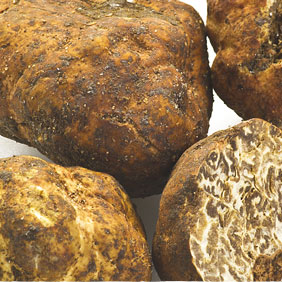
WHITE TRUFFLE – Tuber Magnatum Pico
The white truffle of Alba, or simply white truffle, is definetely the most precious variety of truffles, both from the economical and gastronomic point of view.
Its gleba is unmistakable: it is white and yellow-greyish with tiny white veins, its surface is smooth of ocre-yellow or olive-yellow colour, sometimes also grey-greenish.
Average weight: 8-500 gr
Sizes: 5-25 cm
Collecting times: from the end of September to December
Areas of collection: Piedmont, Emilia Romagna, Tuscany, Umbria, Marche, Lazio, Abruzzo, Molise
Symbiotic plants: usually white willow, white and black poplar, linden, hornbeam, black carpino, oak, roverella oak, poplar carolina, rock rose.
ORDINARY BLACK TRUFFLE – Tuber Mesentericum Vittadiini
Such as Muscat truffles, even the ordinary black looks a lot like the Brumale variety but it differs for its strong smell of phenol. The Glebe is gray brown, but in some specimens, brownish yellow, always with white veins. Precisely for its similarity with the winter truffle, as this presents an ordinary slightly wrinkled surface.
Average weight: 8-500 gr
Sizes: 2-10 cm
Times of collection: from September to January
Areas of collection: Campania, Basilicata, Puglia
Symbiotic plants: usually oak, turkey oak, beech, hazel, black and white hornbeam, black pine.

 +39 030 6950367
